Why Your Behavioral Health Admissions Team Needs a Uniform Lead Rating System
Discover why a uniform lead rating system boosts behavioral health admissions. Learn to score leads, optimize marketing ROI, and convert more qualified patients.
Key Takeaways
- Treating all inquiries equally wastes admissions coordinator time and lowers conversion rates—lead rating prioritizes high-value prospects.
- Lead rating provides a feedback loop from admissions to marketing, focusing on admits.
- A 1–5 star rating system based on clinical fit, payment clarity, and engagement helps track ROI across marketing channels.
- Feeding rated lead and admission data back into ad platforms (Google, Meta) enables value-based bidding and better campaign optimization.
- Connected data systems allow facilities to measure cost per lead, VOB, qualified VOB, and admissions—revealing true channel performance.
The Admissions Challenge
Admissions coordinators are working more inquiries than ever and treating almost all of them the same way. A call comes in, a form arrives, a referral email lands in the queue, and the team works through it more or less in the order it arrived. That approach made sense when inquiry volume was low and every lead looked roughly the same. It does not hold up anymore.
In 2024, an estimated 52.6 million people aged 12 or older in the United States needed substance use treatment. Only about 10.2 million, roughly one in five, actually received it.1
Some of that gap is about access and stigma.
Some of it is about facilities with open beds losing viable admits because of a slow or undifferentiated intake process. Lead rating exists to close the second kind of gap by providing a feedback loop from admissions to marketing that reveals campaigns generating ideal prospective patients.
This article explores:
- What lead rating means for a behavioral health admissions team
- How to build a lead rating model that reflects the way your funnel actually converts and where facilities get this wrong
- How to effectively integrate lead rating by admissions into your marketing campaigns
The Cost of Treating Every Inquiry the Same
In admissions, typically someone gets called first, someone gets called last, and in most facilities that order is decided by whoever happened to answer the phone or grab the next form off the top of the queue. That is a coin flip on which leads are worth the most coordinator time.
The data on response speed is not encouraging for facilities running on a first-in, first-out queue. A widely cited Lead Response Management Study, along with research associated with InsideSales.com and MIT, found that the odds of qualifying an inbound B2B lead drop sharply once the first several minutes pass without contact and fall by as much as tenfold after the first hour.2
Separate research from Salesforce found that only about 27 percent of B2B leads ever receive any follow-up contact at all.3
Behavioral health admissions is not a typical B2B sales funnel, but the underlying mechanism is similar. Lead rating can make a significant difference to call sequencing, but especially for marketing analytics.
What Lead Rating Actually Means for an Admissions Team
Lead rating in Behavioral Health centers is designed to:
- Understand campaign effectiveness and ROI per marketing channel, allowing you to compare them and focus on the campaigns that deliver the best results.
- With a uniform lead rating system, you ensure data integrity across all platforms and channels. Over time, the compounded effect of uploading qualified opportunities and admit data into your ad platforms, such as Google Ads, Meta Ads, and, in the future, ChatGPT ads, enables the publishers to focus on which audience to target. This increases your visibility to prospective patients who meet your ideal client profile and payor mix.
- Provide concise performance reporting on the metrics that truly matter, enabling admissions, marketing, and executives to analyze performance through the same lens.
In B2B software sales, lead rating usually combines firmographic fit, whether a company looks like the vendor’s best customers, with behavioral engagement, whether a prospect has taken actions that signal real intent. Behavioral health admissions needs its own version of both.
Fit signals for a treatment center include:
- Level of care match—whether the inquiry describes symptoms and history consistent with what the facility is licensed to treat
- Insurance or payment fit—whether coverage is plausible for the plan or self-pay capacity is established
- Geographic fit—whether the person can realistically reach the facility or needs a referral elsewhere
- Genuine intent and willingness by the prospective patient to take action and enter treatment, based on established intake criteria
Behavioral signals include:
- How the inquiry arrived, since an inbound phone call generally signals more urgency than a static form fill
- Whether an insurance carrier and policy ID were provided
- The time of the inquiry, since a call at 2 a.m. can signal crisis-level urgency rather than simple inconvenience
- The quality of the referral source, since a call transferred from a known clinician or discharge planner scores differently than a cold click from a paid search ad
None of this decides who deserves help. Every inquiry should be answered. Rating determines the inquiry’s status and enables tracking the ROI of each marketing channel.
A Guide to Effective Lead Rating for Behavioral Health
Accurately rating the quality and potential of calls and leads is instrumental for optimizing campaign performance, whether via Google Ads, Meta Ads, Microsoft Ads, Recovery.com, SEO, or any other marketing channel.
For Behavioral Health organizations, by rating and integrating leads, VOBs, and admissions data across all marketing channels in multichannel dashboards, focus can be directed to the most impactful campaigns by distributing budget allocation where it’s most effective from an ROI standpoint.
elev8 collaborates with your admissions team, requesting them to evaluate and score every single call/lead received from your marketing campaigns. Depending on your contracts and qualification process, it’s possible to better understand what quality opportunities look like for your team and how effective they are at getting them scheduled for admission.
This helps optimize your lead generation efforts by driving more of the qualified prospective patients with the highest possible potential for admission.
The Census: The elev8 Newsletter
Join 2,000+ behavioral health leaders. Get notified when we publish new articles — the strategies, data, and insights shaping behavioral health marketing.
2,000+ executives already subscribed
Unsubscribe anytime. Just one newsletter a month — no spam.
Star Lead Rating System
A workable starting model weights three categories:
- Clinical and level-of-care fit
- Coverage or payment clarity
- Engagement signal
In most facilities, insurance verification status and level-of-care match carry more predictive weight than channel or time of day, but that balance shifts by facility and by program.
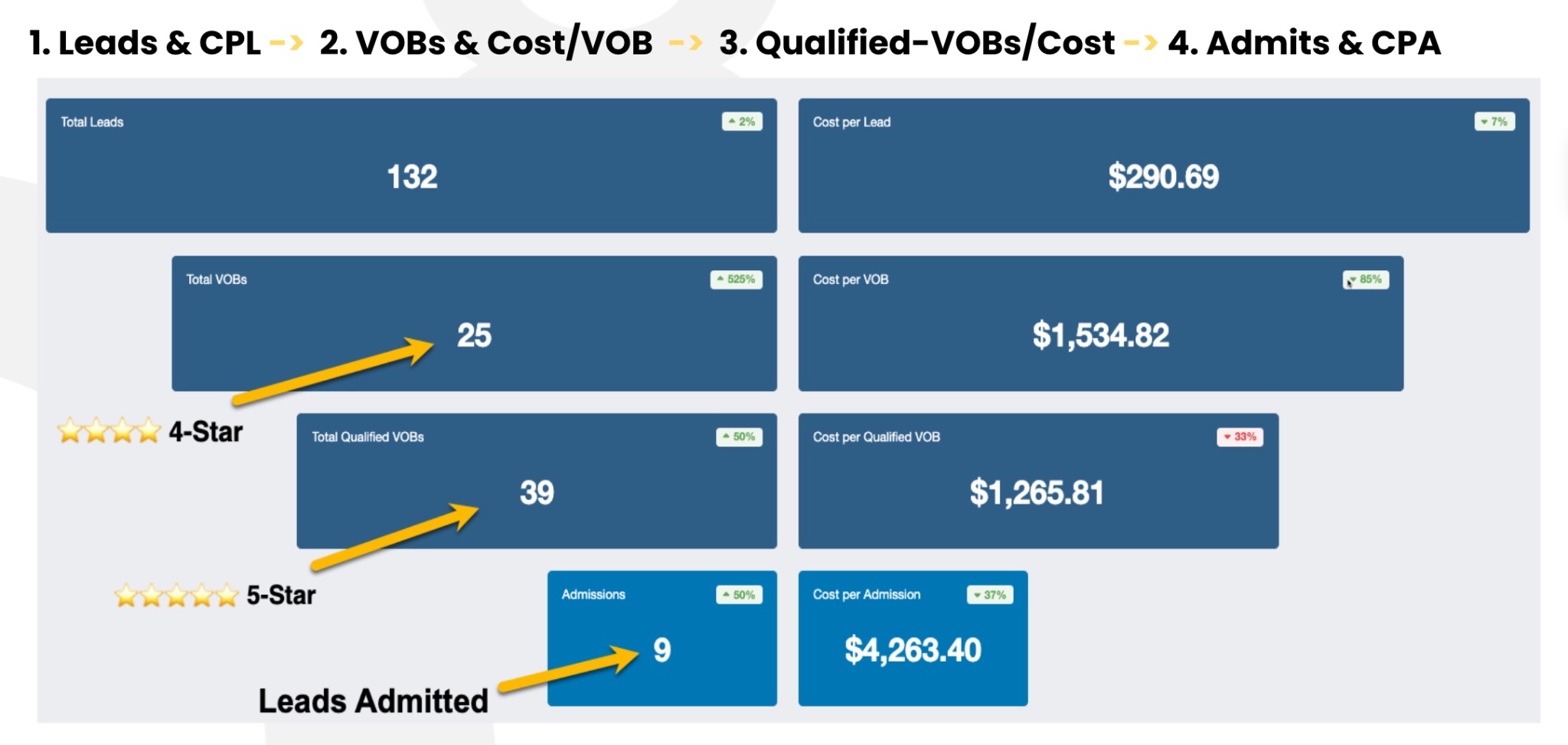
In partnership with CTM, elev8 has developed an effective 1-5 star rating system tested across multiple large and small facilities, and it consistently works. Moreover, it allows us to focus on and measure a few key performance metrics for success, focusing on the 4- and 5-star-rated leads, while segmenting the leads further as an opportunity (4-star) or a qualified opportunity (5-star). This approach can apply to any organization regardless of payer mix and contracts in place.
- ⭐ 1-Star. Completely unrelated to program offerings or business services, e.g., sales calls, spam, or other non-relevant inquiries.
- ⭐⭐ 2-Star. Existing relationships, such as vendors, partners, or other stakeholders of the company.
- ⭐⭐⭐ 3-Star. Potential patient with Medicare, Medicaid, other government insurance, or no commercial insurance.
- ⭐⭐⭐⭐ 4-Star. Insured individual with intent and verification of benefits (VOB) initiated to determine if there is a qualified opportunity for your facility.
- ⭐⭐⭐⭐⭐ 5-Star. Fully qualified VOB or cash-pay client.
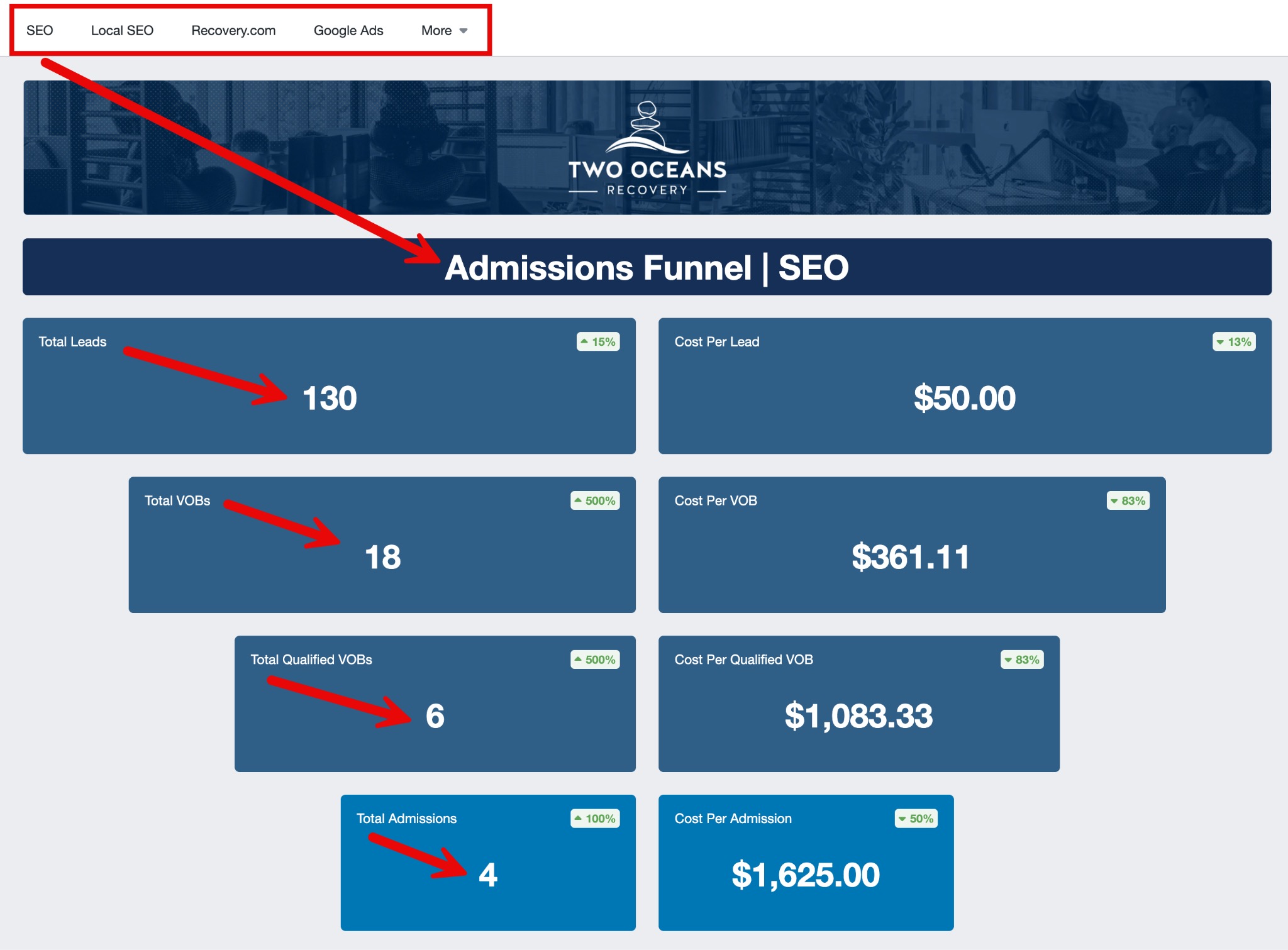
The image below shows how the calls/leads that you rated will be fed into your marketing reporting dashboards. This provides a clear-cut view on performance, allowing you to benchmark your primary admission metrics and KPIs across all channels:
1. Leads & Cost Per Lead → 2. VOBs & Cost Per VOB → 3. Qualified VOBs & Cost → 4. Admits & Cost Per Admit
With the same lead system applied to all your marketing campaigns, you can, at a glance, determine which of your channels are bringing in most admits and providing you with the highest ROI.
Admissions Reporting: Converting Leads to Admits
When leads (calls, forms, texts, emails) turn into an admission, team members report on the opportunity won by converting the initial inquiry into an admission. You can also add a monetary value, but it’s optional. Most facilities add a value that reflects their average length of stay and reimbursement rate per patient to better compare their return on investment across all marketing channels.
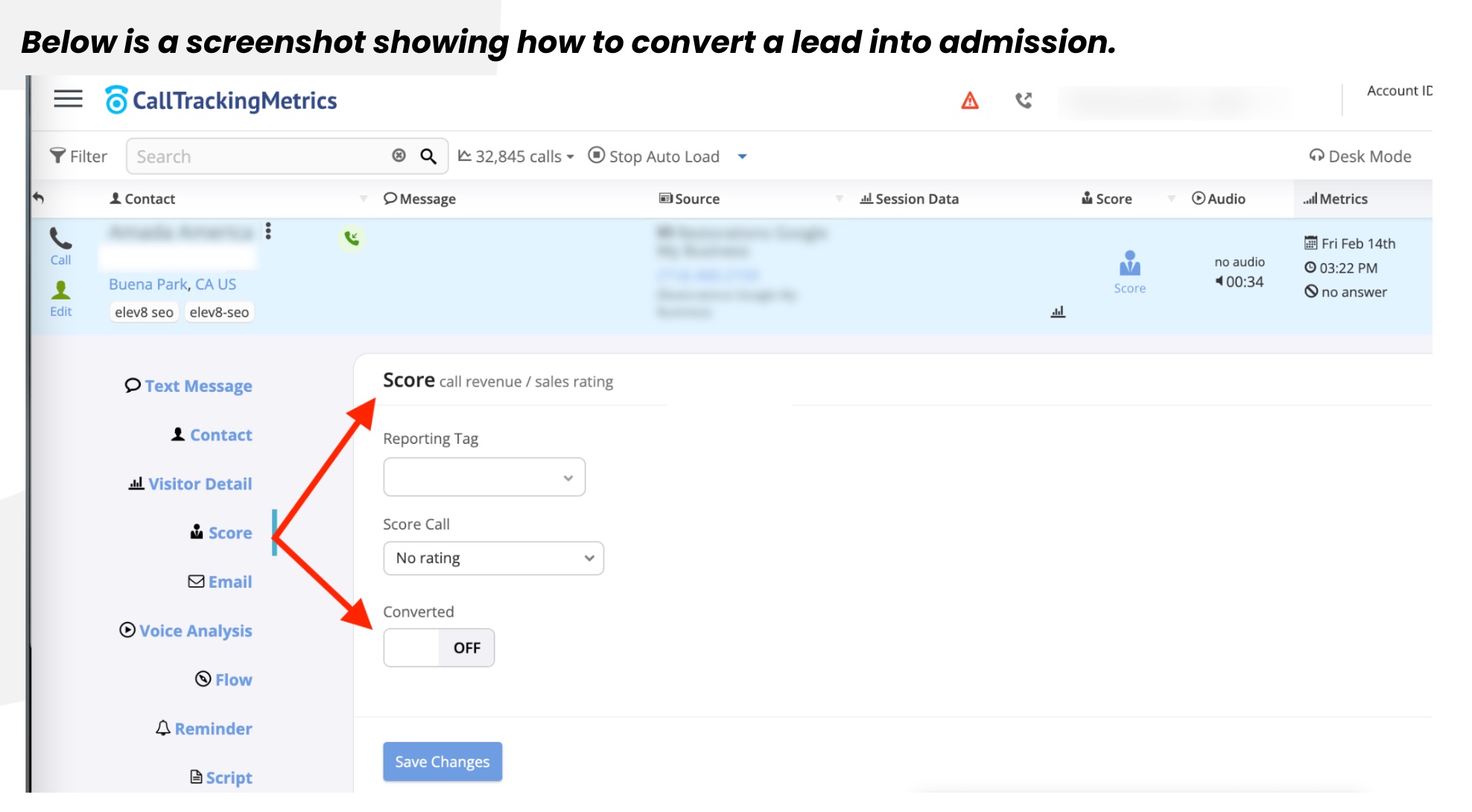
Note: Facilities that integrate CTM with their CRM, preferably Salesforce or e8 Platform, can rate leads and opportunities directly from the CRM by leveraging bi-directional field mapping.
Turn Lead Rating Data Into Better Advertising Performance
Lead rating should do more than improve reporting or help admissions teams categorize inquiries. When properly connected to the advertising platforms, it creates a feedback loop that teaches campaigns which inquiries produce viable verification of benefits opportunities and, ultimately, admissions.
Many behavioral health campaigns are still optimized around shallow conversion signals. An agency or in-house team may count any call lasting longer than three minutes as a conversion. Others optimize toward every inquiry that reaches the VOB stage, regardless of whether the individual’s coverage, clinical needs, level of care, location, or readiness make admission realistically possible.
These signals may increase the number of conversions reported inside Google Ads, but they do not necessarily increase the number of qualified patients or admissions. When every three-minute call is treated equally, the advertising platform is trained to generate more calls—not necessarily more viable opportunities.
Lead Rating Focused on Business Outcomes That Matter
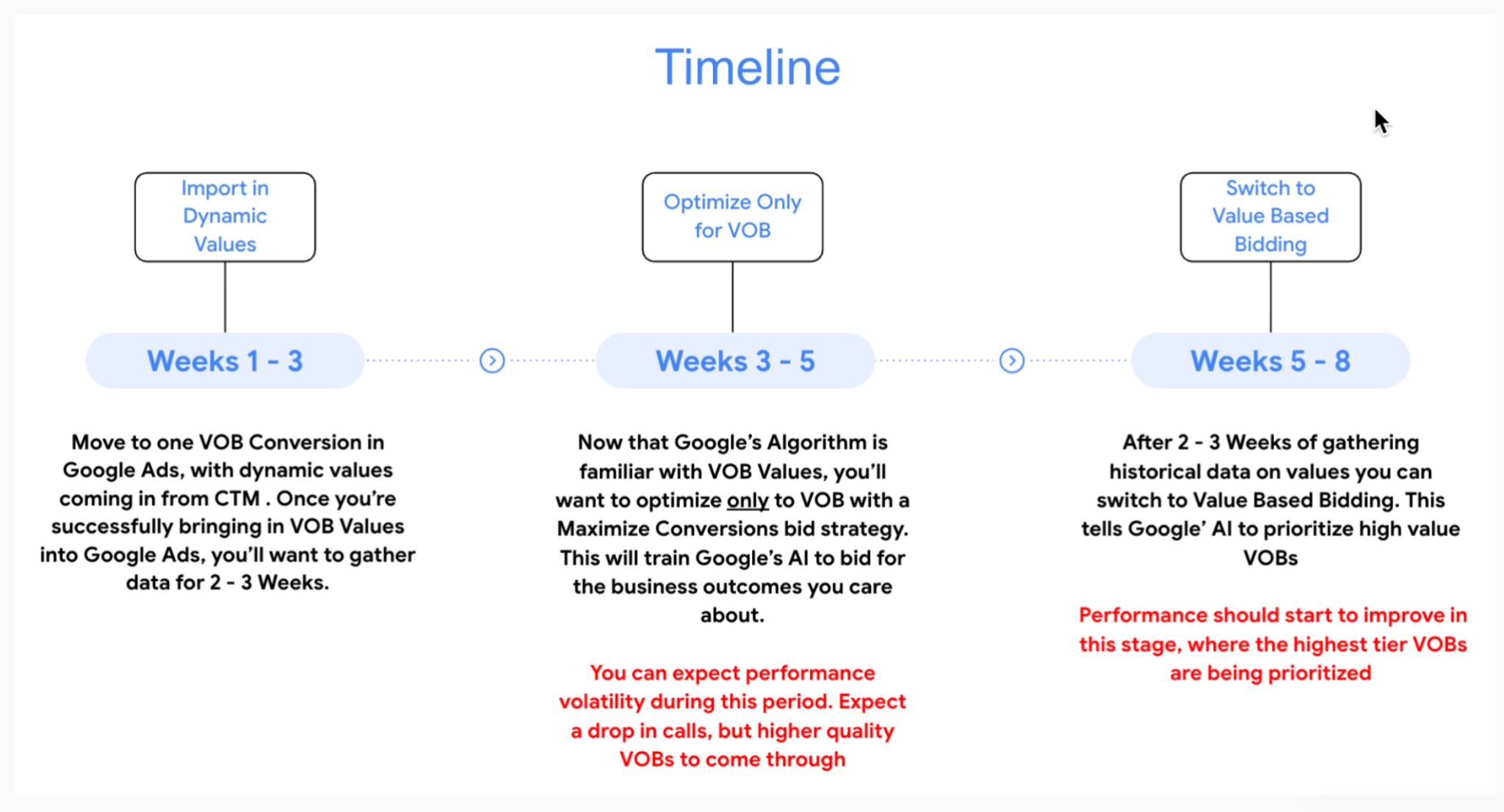
At elev8.io, we use a closed-loop conversion framework developed in collaboration with CTM. Lead rating, VOB, qualified VOB, and admission data flow automatically from the admissions infrastructure back into Google Ads. The same underlying methodology can be extended to Meta Ads and other publishers where compliant offline conversion integrations are available.
Rather than optimizing around call duration or raw inquiry volume, the process focuses on the business outcomes that matter:
- Import qualified outcome data. Viable VOBs and admissions are automatically imported into the advertising platform as offline conversions.
- Optimize for viable VOB volume. Once sufficient data has accumulated, the platform is instructed to maximize conversions specifically around viable VOBs—not every phone call or inquiry.
- Introduce value-based bidding. Different conversion outcomes can be assigned different values. For example, a viable VOB might be assigned a value of $2,500, while an admission might be valued at $5,000. These are illustrative values and should be calibrated to the facility’s payer mix, reimbursement profile, average length of stay, and historical conversion data.
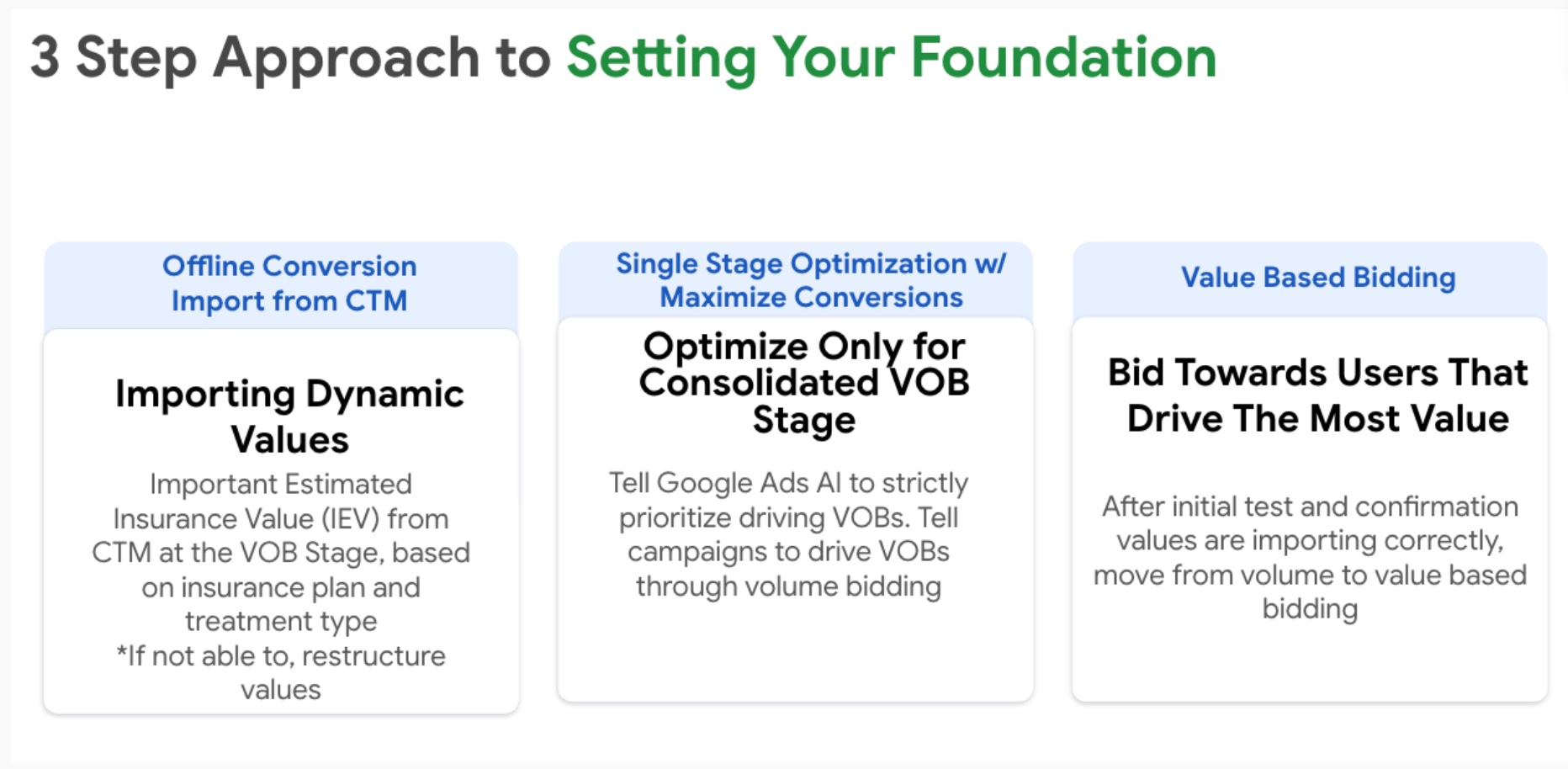
Once the platform receives enough reliable outcome data, its bidding system can begin allocating budget between campaigns, search queries, audiences, and individual auctions based on the probability of producing the outcomes the facility values most.
Google’s systems have access to substantial contextual and behavioral signals, but healthcare advertisers must operate within strict privacy and personalized advertising restrictions. The advantage does not come from assuming that Google knows a prospective patient’s insurance coverage. It comes from securely feeding the platform accurate, compliant, first-party conversion outcomes so its algorithms can learn which advertising interactions are most likely to result in viable VOBs and admissions.
In an episode of the elev8.io Podcast, Gary Garth discussed this strategy with Trevor Rand, Google Account Strategist and SUD Vertical Specialist. The relevant value-based bidding discussion begins around the 19-minute mark, where Rand explains why behavioral health facilities should move beyond clicks, calls, and other surface-level conversions and optimize campaigns around outcomes with measurable business value.
The below timeline is presented as an example implementation sequence, not a guaranteed performance schedule.
The Compounding Advantage of Connected Admissions Data
The future winners in behavioral health will be the facilities with the strongest data integrity.
When call tracking, admissions, CRM, VOB, clinical-fit, payer, and admission data remain isolated in separate systems, marketing teams cannot see which campaigns are generating qualified patients. Admissions teams cannot consistently classify opportunities. Executives are left comparing incomplete reports that use different definitions of success.
A connected data structure changes that. When the same lead-rating methodology is applied across every marketing channel, facilities can follow the complete admissions funnel:
Lead → VOB → Qualified VOB → Admission
They can then measure the cost and conversion rate at every stage:
Cost per Lead → Cost per VOB → Cost per Qualified VOB → Cost per Admission
This allows leadership to compare SEO, paid search, directories, referral sources, and other campaigns through the same performance lens. Instead of asking which channel generated the most calls, the organization can identify which channel generated the most viable patients, admissions, and revenue.
The value of this infrastructure compounds over time. Every properly rated inquiry, completed VOB, and recorded admission gives the organization a more complete picture of its ideal patient profile, payer performance, campaign quality, and true acquisition costs. That information improves executive reporting while simultaneously creating better optimization signals for the advertising platforms.
We have tested this methodology extensively across behavioral health facilities of different sizes, service lines, markets, and payer mixes. While results depend on sufficient conversion volume, accurate classification, proper technical implementation, and market conditions, the pattern has remained consistent: campaigns perform more efficiently when they are optimized toward viable downstream outcomes instead of proxy metrics such as call duration.
In one facility, the campaigns were initially optimized around calls exceeding a specified duration. We replaced that signal with viable VOB data and used the resulting outcomes to guide campaign optimization. Within approximately three months, monthly admissions increased from 380 to 470—an increase of 90 admissions in a single month.
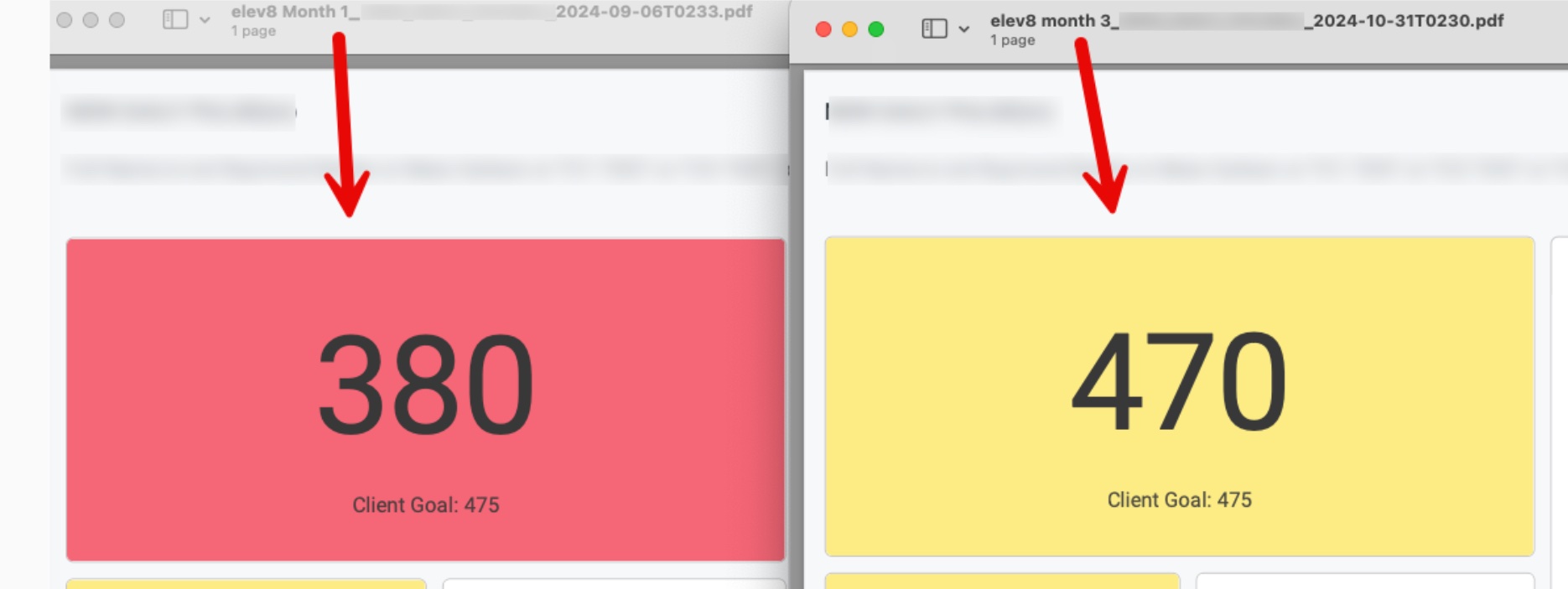
The facility did not achieve that result merely by buying more traffic. The defining change was improving the quality of the signal used to guide bidding and budget allocation. Rather than telling Google to generate more long calls, the facility began teaching the platform what a viable prospective patient looked like based on actual downstream outcomes.
Lead rating does not change how many inquiries reach your admissions team. Facilities that build a rating model around their own admit data keep every inquiry in the contact queue and report on results in the dashboards. And they recalibrate the model against outcomes.
This is why lead rating should not be viewed as an isolated admissions tactic. It is the foundation of a closed-loop patient-acquisition system connecting marketing investment to admissions and revenue.
Facilities can use the elev8.io Behavioral Health ROI Calculator to model how improvements in qualified VOB volume, conversion rates, cost per admission, and patient value could affect their financial performance.
What Would Better Lead Data Do to Your ROI?
Model how improvements in qualified VOB volume, conversion rates, and cost per admission would affect your bottom line.
Sources
- SAMHSA. (2025). SAMHSA releases annual National Survey on Drug Use and Health.
- Lead Response Management Study; research associated with InsideSales.com and MIT, as reported in Lead response time statistics. GreetNow.
- Salesforce research, as reported in Lead response time statistics. GreetNow.

Head of Growth · elev8.io
Freddie Francis is Head of Growth at elev8.io, where he partners with behavioral health executives and industry leaders to uncover growth opportunities across the entire patient journey—from lead generation and admissions enablement to CRM optimization, operational efficiency, and long-term census growth.
Freddie holds nearly a decade in marketing and new business development, and has been focused on behavioral health since 2022 — four years — improving how clients leverage data-driven approaches to build predictable growth systems while improving the experience for both patients and admissions teams in behavioral healthcare organizations.
Freddie shares insights on patient acquisition, admissions performance, behavioral health marketing, AI-enabled growth systems, and revenue operations.
SEO vs. PPC for Addiction Treatment Centers: Which Delivers Better ROI?
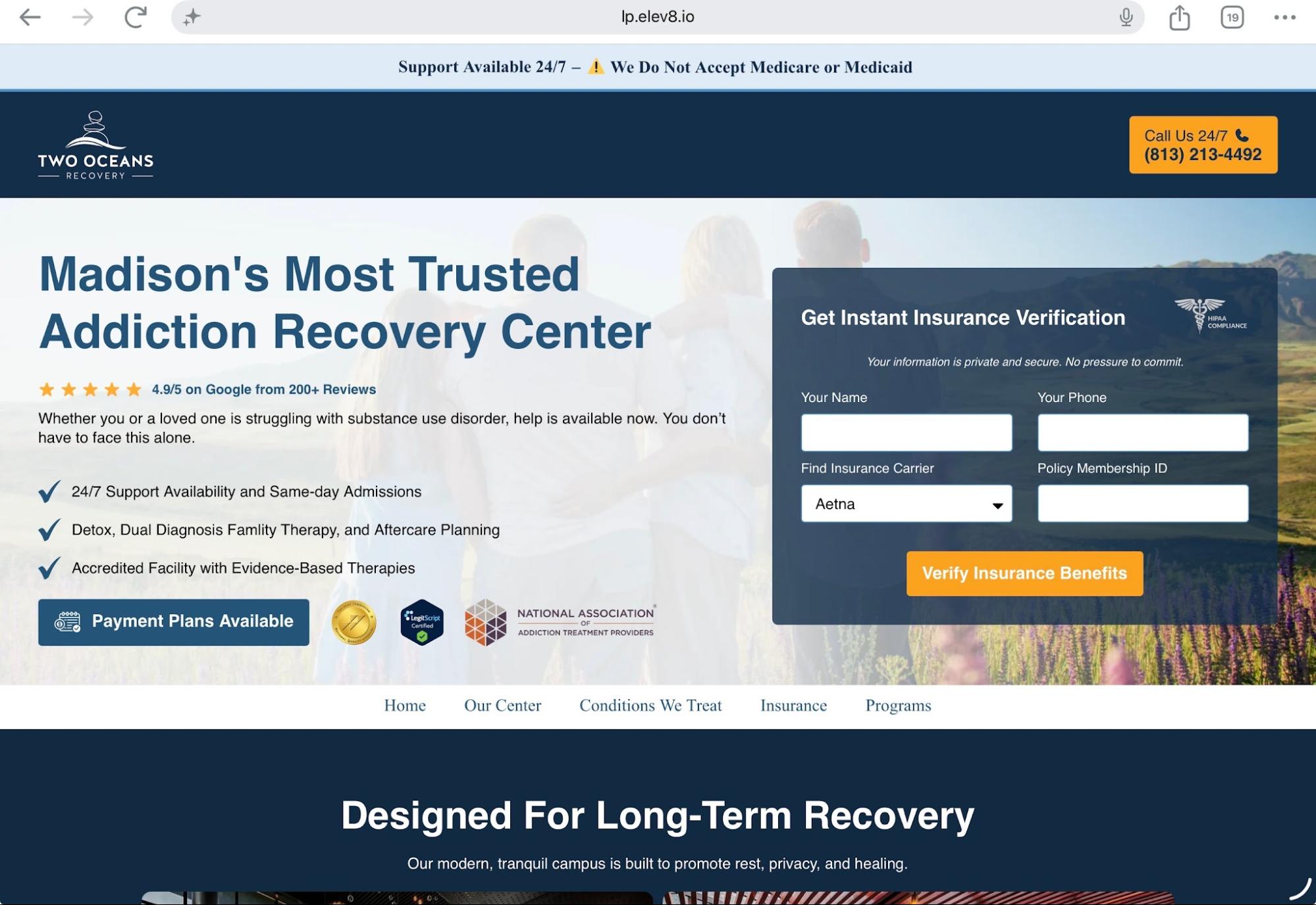
From Fear to First Call: How to Build a High-Converting, VOB-Optimized Landing Page