Gary Garth Speaks at the Recovery.com Summit 2026
Gary Garth on aligning sales and marketing, building AI visibility, and turning alumni into brand ambassadors — a first-person recap of the Recovery.com Marketing Summit 2026 panel on patient acquisition.
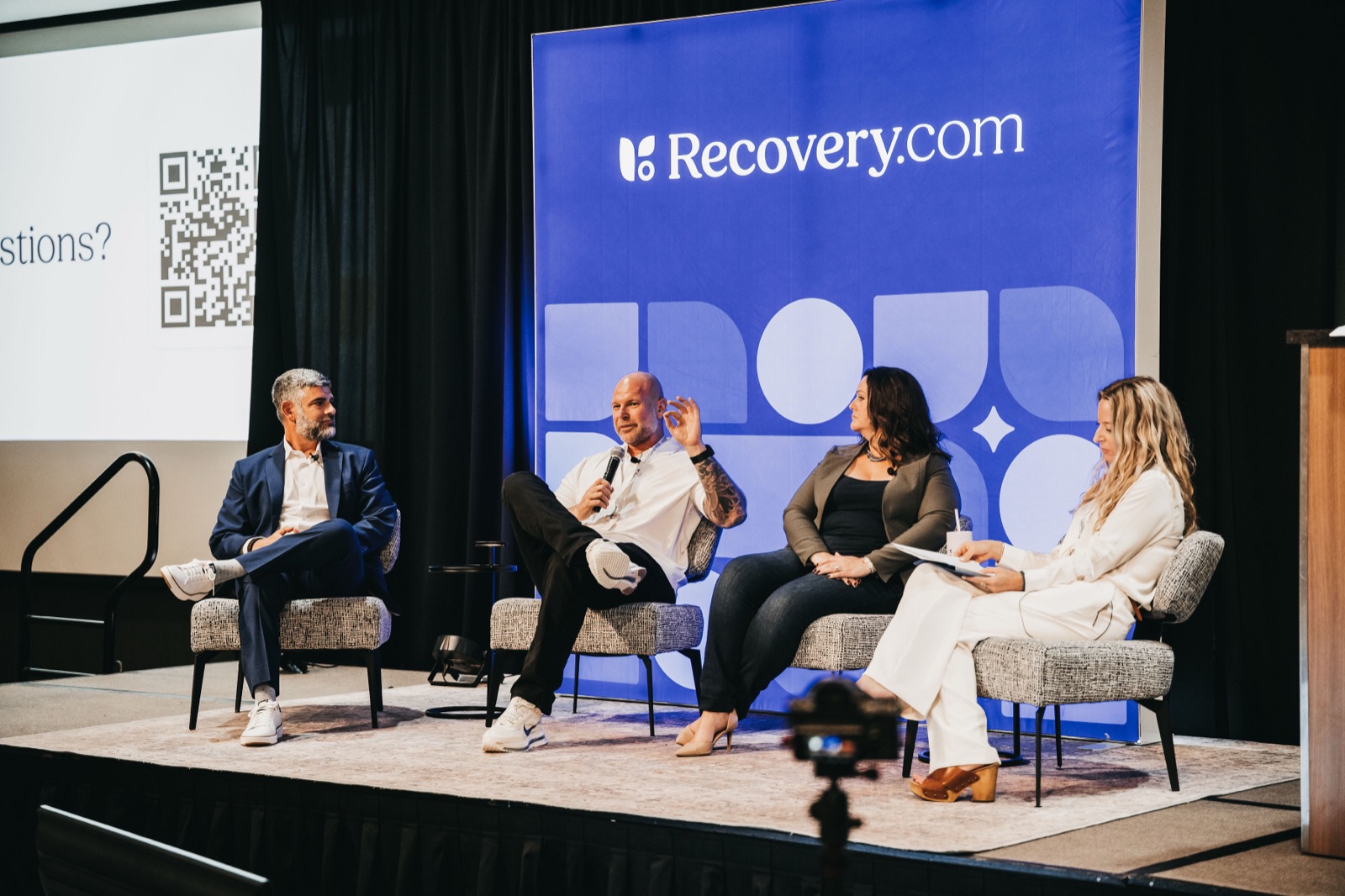
I had the honor of joining a panel called ‘The Agency Perspective’ at the recent Recovery.com Marketing Summit 2026 in Madison, WI, from July 20 to 22. It was a focused, intimate event with 120 attendees, 9 sponsors, and 30 speakers. My remarks are lightly edited here.
That size let us really exchange experiences on topics like the future of behavioral health marketing, patient acquisition strategies, AI visibility, workflow adoption, and digital innovation without losing clinical integrity.
I started by emphasizing foundations: clear attribution, real goals, and benchmarks that match reality. Multiple touchpoints. Trust. You have to earn that before you scale.
Key Tactics to Consider
Signe asked about specific tactics. A couple you can do immediately:
Someone at the summit mentioned that only 3% of LinkedIn posts reach your target audience. So what you think is getting visibility? Consistency matters, and authority matters — Google’s E-E-A-T guidelines still hold.
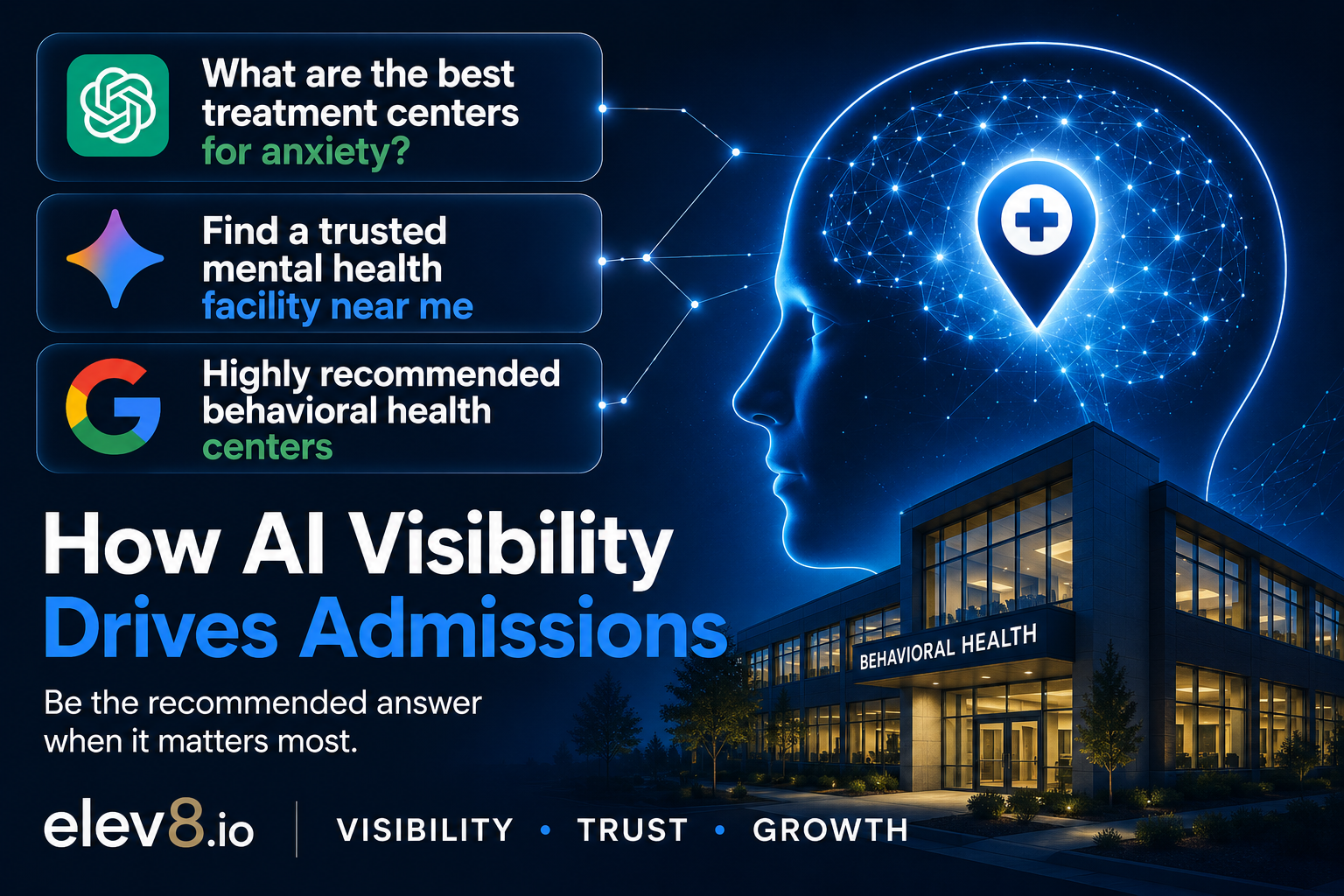
Plagiarized content or straight ChatGPT copy won’t cut it. Have your content medically reviewed. Use sources. Cite things. If you do that consistently, on the right website framework, you will get AI visibility. That’s the slam dunk.
Earned, Owned, and Paid Media
Everybody in this room can probably double their earned, owned, and paid media. You should dominate earned and owned media and try to get as much as possible.
For paid, if you’re paying for it, make sure you have conversion tracking attribution in place so you can take all of these conversions and say, “Okay, this is our ideal patient profile with this payer mix,” and then push it back to Google, saying, “This is the audience we’re targeting.”
That’s why Meta Ads and Google Ads can be so effective when set up properly: they will start gaining visibility in places with the highest probability of converting. Show your most relevant ads, and they can enhance that signal if you feed it the right information.
So stop treating it like gaming the system. Stop siloing your data and consolidate it, and push it back to the publishers, the platforms that get very good returns as a result.
The Census: The elev8 Newsletter
Join 2,000+ behavioral health leaders. Get notified when we publish new articles — the strategies, data, and insights shaping behavioral health marketing.
2,000+ executives already subscribed
Unsubscribe anytime. Just one newsletter a month — no spam.
Diversification and Multichannel Strategy Are Critical
I think reimbursements and all the disruption that’s been occurring with payers is challenging. There’s a predicted revenue, and then all of a sudden a channel appears to be profitable, and then thirty or forty percent less is paid out.
So I think it’s more about being less dependent on channels or specific strategies and implementing some diversification so that you’re more risk-averse.
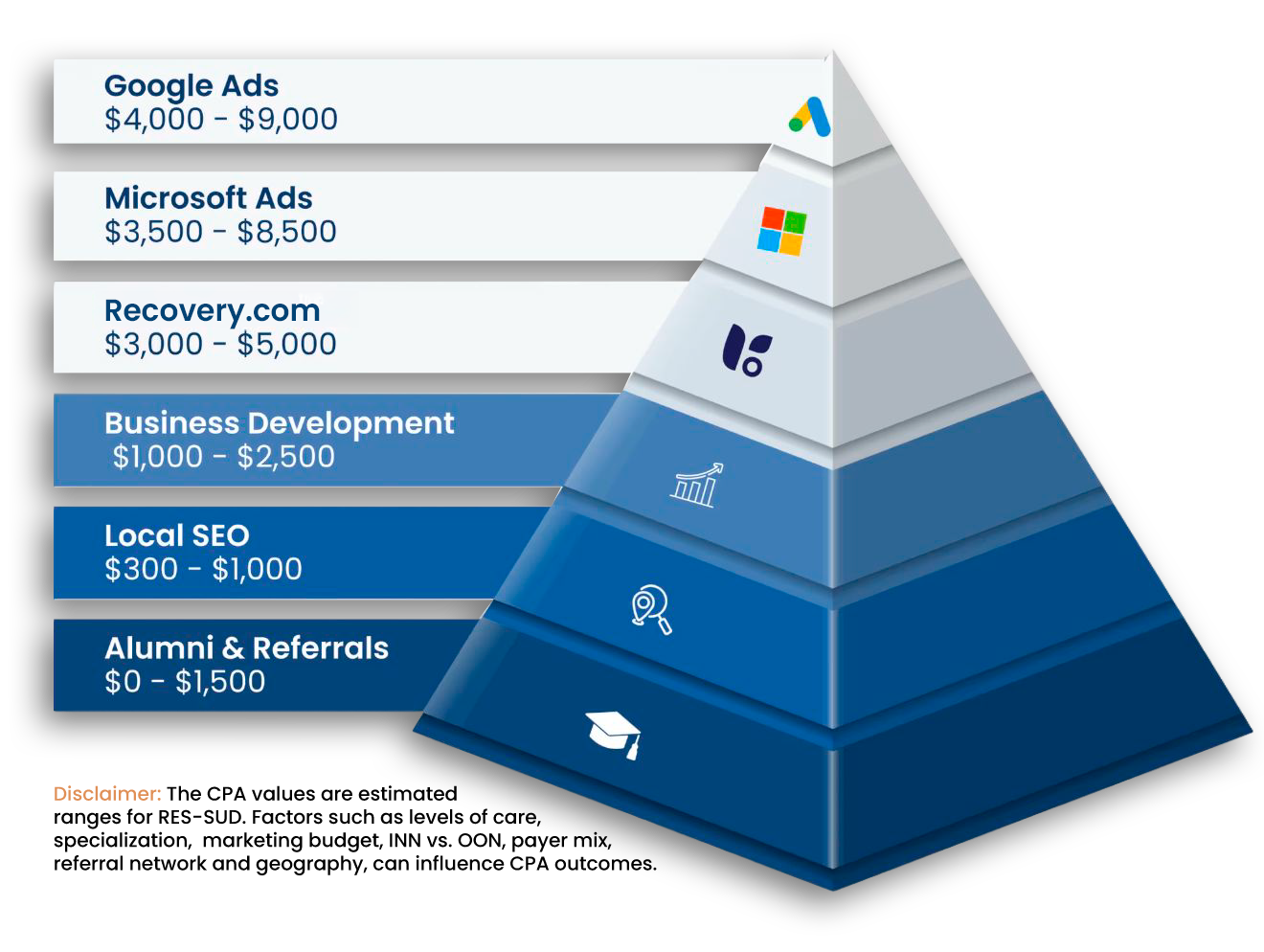
Very often I see some facilities putting all their money into Google Ads, but do you really want to put all your eggs in that basket? It’s difficult to rely on just one channel, so you need a multi-channel strategy.
Ideally, I don’t like working purely with out-of-network facilities. It’s almost like fishing for Bluefin tuna. You have to generate twenty VOBs to get that one qualified VOB.
So I think the biggest challenge is that many facilities feel like they’re playing whack-a-mole, right? By that I mean once we get the marketing going, then, oh, shoot, we have an admissions problem, right? Leads are falling through the cracks. All of a sudden, there’s no alignment between BD, admissions, and marketing, and there’s a war over attribution, fixing your CRM, and who actually gets accredited for an admit.
And as a result, we waste a lot of energy instead of creating a strategy that is in harmony and complements the other elements. So diversification and a multi-channel strategy across the core patient acquisition teams can help a lot.
Key Elements of the Smarketing Tech Stack
I’ll start with the fundamentals of integrating sales and marketing into a Smarketing approach. Maybe I sound like a broken record, but let me go back to tracking and attribution.
When clients come on board with us, we’re very adamant about having them follow the proven elev8 framework: not because we’re arrogant or very rigid. It’s because it works.
You need to have a lead rating system in place, and most providers have some call tracking software and a telephony system but no proper integration with admissions and marketing processes. We default to CTM. I think it’s more technically robust.
And a lead rating system doesn’t necessarily have to be integrated with your CRM, but it’s highly recommended, although most don’t have it, or they haven’t mapped it appropriately. It will make your admissions life much easier. But when folks come to us, that’s the starting point.
What contributed to an admit? It’s never really only one channel once you start digging deep. Knowing that is foundational.
4 Metrics That Truly Matter
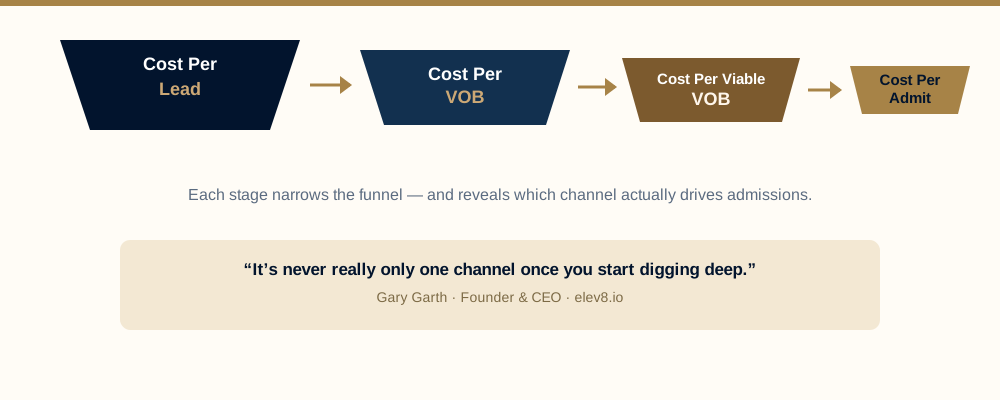
Then, obviously, having marketing automation with proper nurturing is important. At elev8, our account managers, on a weekly basis, go in and take a portion of calls to analyze. They use a process script to assess how the call was managed.
Was it dispositioned properly? Did they follow the process? We do this work because we know we’ll get fired if the ROI, the return on ad spend, isn’t in place. So if you start digging into your organization, you’ll see that there are very often only two follow-ups.
Understanding the world of an addict is pivotal. Entering treatment is not just something they decide overnight, and then they’re going to get started tomorrow. It’s something that maybe, when all the stars align, you get into treatment. So consistency with follow-ups is non-negotiable. Being there top of mind for when all the conditions are in place for them to be able to move forward.
Text messages, emails, follow-ups, and calls are especially important as you enter Q4, which is typically very challenging for many facilities due to seasonality and the significant investment that large providers make in Google Ads, leading to increased competition and higher costs.
That’s when having a good database of opportunities that never converted, with you consistently following up, becomes particularly valuable. It’s not just from a business standpoint, of course, but also about being there to help those in suffering get started on their path towards recovery.
Do You Know Your Metrics?
Most clients ask about AI visibility before they know their own numbers. Start with the metrics, and the right questions follow.
Alumni: Your Overlooked Brand Ambassadors
And then for me, something we focus a lot on right now is alumni. Why? Because those alumni turn into reviews, for one. They’re your brand ambassadors. I always challenge my clients: if you have thirty discharges each month but only two reviews last month, what’s going on? What’s up with that?
Ask for the review early on in the treatment journey. It will also help your Recovery.com profile in addition to your Google Business Profile. It will help any marketing channel. It’s also fuel for your AI visibility and overall trust.
You can also place your alumni videos everywhere to enhance brand credibility and conversion rates. On that note, Recovery.com actually has a program where they will send a video photographer to your facility and shoot a free video of your alumni. Then you can publish them on all your profiles, your landing pages, your website, and your social media platforms. In short, you can distribute them everywhere, and it really enhances trust.
But, if God forbid, they should relapse — instead of feeling that shame and guilt, “Ugh, I can’t call back, and nobody’s been in contact with me since discharge, I’ll contact another facility instead” — now you just lost a readmission and your relationship with your client.
And this scenario happens much more often than most think. Forty to sixty percent of patients regress, right? They relapse after the first treatment phase, the statistics confirm. So you need to be in front of them, and from a marketing and ROI standpoint, it’s extremely sustainable.
And please don’t make the alumni department be one person sitting in the garage with no resources allocated. Put a lot of money behind the Alumni program since it will fuel your brand, reputation, and admissions growth.

Future Directions: Using AI Strategically
I’m excited for the industry because, as I’ve mentioned in the past, I entered this field for personal reasons: people near and dear to me ended up in the hands of the wrong facilities. And that’s because you could game the system, and I think that’s going to stop now.
I love AI from a marketing standpoint. I absolutely love it. It’s not about reproducing content, cutting corners, or plagiarizing content. But if you use AI strategically now, you can get the visibility that you deserve.
The brands that have good domain authority, an established brand, tons of reviews, proven programs, and clinical outcomes published on their websites are patient-centric. They have tons of alumni testimonials. They’ll become the winners with AI.
The facilities that are really doing good work and can prove it will be favored in AI visibility. So I think that weeds out all these lead aggregators running campaigns with unbranded landing pages, primarily out-of-state targeting, who have to speak with the callers for twenty minutes in a misleading context with the objective of trying to get them to fly across the country to another facility that they didn’t realize they called in the first place.
Smarketing Means You Know Your Metrics
Lastly, make sure that the BD team is working in tandem with your Marketing team. I call this Smarketing — making sure that sales and marketing are coming together with one uniform strategy.
And if you understand your metrics and your desired business outcomes, if you’re working on improving all your metrics, whether it’s your AMA rates or review generation, if you have a proper intake, discharge, or step-down process, you will increase the lifetime value per patient and grow cost-effectively. This sustainability allows us to help more people get the care they deserve.
So that’s my encouragement to everybody. Make marketing a priority and involve your entire team, including leadership.
In Summary
I’m very, very excited about AI. We have a ton of tools I can recommend. For one, on our website we have a free ROI calculator. Go through it. Most clients come to me and ask about AI visibility. Then I say, do you know your metrics in the first place? Just start there, right? If you focus on the numbers, you will start asking the right questions.
And if you’d like to listen to the full Recovery.com panel discussion, you can find it here: watch the panel recording.
The playing field is leveling out, and that’s a great thing for facilities truly committed to quality care. No more gaming the system. No more misleading tactics. When you invest in your brand, your alumni, AI, and your clinical outcomes, the results speak for themselves.
Is Your Site Even Visible to AI?
Try the tool now to gauge your AI visibility, Core Web Vitals, HIPAA compliance, security, and overall performance.

Founder & CEO · elev8.io
Gary Garth is the Founder & CEO of elev8.io, where he helps behavioral health organizations achieve full census through integrated marketing, admissions, and technology-driven growth systems.
With more than a decade of experience working alongside Google, Microsoft, and high-growth technology companies, Gary has built and implemented scalable growth frameworks now used by 55+ treatment centers across the United States to drive admissions and operational efficiency.
As a speaker, Gary focuses on the intersection of patient acquisition, AI-driven search, and admissions performance, helping founders, operators, and investors identify the hidden bottlenecks limiting growth—and how to fix them.
The author of The Zero to 100 Million Sales Blueprint and The Goals, Grit & Greatness Planner™, Gary is driven by a mission to close the gap between the millions of people struggling with addiction and mental health and the care they need.